
Forearm Pain and Wrist Tendonitis
(A Complete Guide with Relief Exercises)
Written by: Nurudeen Tijani (Wellness and Pain Relief Fitness Coach)

Article Summary
- Individuals involved in strenuous hand-related occupations, physical activities, or repetitive tasks may develop tendonitis in the forearm or wrist.
- The primary causes include chronic inflammation, magnesium deficiency, and muscle restriction.
- Why it becomes chronic: Even when the painful area is treated, symptoms return due to muscle stiffness, how muscles and tendons absorb stress, and compensation patterns over time.
- While it’s possible to experience one without the other, forearm issues often place added stress on the wrist, which is why many people experience both at the same time.
- This article explores these causes and outlines effective non-surgical self-treatment and prevention strategies for managing forearm and wrist pain.
Key Points
- Root Causes: Chronic inflammation, lack of magnesium, and muscle restriction are the primary causes of pain in the forearm and wrist.
- Conditions and Injuries: Common injuries include brachioradialis tendonitis, wrist flexor tendonitis, wrist extensor tendonitis, wrist ganglion cyst, ulnar styloid prominence, thumb pain/strain, neuropathies and nerve compression syndromes
- Symptoms: Common symptoms include burning or stinging pain in the forearm, redness, swelling, tenderness, dull or sharp discomfort, difficulty gripping, pain on the thumb or pinky side of the wrist, pinching or tingling sensation at the tip of the fingers, and radiating pain in the forearm and hand.
- Non-Surgical Treatment: Use self-myofascial release (SMR) exercises to massage and keep the forearm muscles pliable. SMR is an effective and reliable way to relieve pain in the forearm and wrist.
Eliminate Forearm and Wrist Pain — Without Guesswork
Our step-by-step program is designed to eliminate forearm and wrist pain fast. Ready to get started?
Causes of Forearm Pain and Wrist Tendonitis
Root Cause #1: Magnesium Deficiency
Around 70 to 80% of people in the U.S. are magnesium deficient, which significantly impacts muscle and tendon health, particularly in the forearm and wrist.
Calcium helps muscles contract, while magnesium aids in relaxation. Excess calcium causes muscles to remain tense, straining tendons and leading to joint inflammation and pain in the forearm and wrist.
Magnesium dissolves calcium, preventing the calcification of soft tissues. Calcification hardens tendons and muscles, leading to tendonitis and joint pain.
"The Magnesium Miracle" highlights that heavy exercise, caffeine, stimulants, diuretics, stress, and dehydration deplete magnesium levels.
Further, calcium is a direct cause of inflammation. Conditions ending in "itis" (like tendonitis) indicate inflammation and a lack of magnesium.
Therefore, individuals engaged in strenuous professions or physical activities must actively replenish magnesium in their bodies.
40% of magnesium in the body is in the muscles. Twitching muscles, muscle cramps, and muscle spasms are signs of low magnesium levels in the body. - The Magnesium Miracle - Discover the Missing Link to Total Health, By Carolyn Dean, MD, ND
Root Cause #2: Muscle Restriction
With the body deficient in magnesium, the forearm and wrist muscles—including the brachioradialis, wrist flexors, extensors, and tendons—are more likely to become tense, lose elasticity, and contract over time.
Muscle restriction refers to inelastic, tight, shortened, knotted, or tender tissues. It occurs when inelastic fibers shorten and cannot relax to their normal state.
Lifting, pulling, pressing, or repetitive gripping actions can overstretch and overload the forearm muscles, leading to restriction. This restriction is the trigger that initiates pain in the wrist and forearm joints.
When these muscles become restricted, they shorten and tighten. The tightness puts tension on the tendons attached to the joints, leading to inflammation and discomfort.
Root Cause #3: Chronic Inflammation
When the body is deficient in magnesium and the forearm muscles are restricted, repetitive tendon and muscle strains can lead to chronic inflammation in the wrist.
This inflammation results in a 'burning' sensation and pain known as tendonitis.
A burning sensation and discomfort indicate acute inflammation, which is usually temporary and resolves with healing. If the pain persists for more than three months, it becomes chronic.
If the body's healing process fails, chronic inflammation can occur, which prevents proper healing of muscles, tendons, and ligaments, leading to chronic tendonitis in the forearm and wrist.
Note: Apart from tendon issues, various kinds of injuries and medical conditions can cause wrist problems. Here is an article from the Cleveland Clinic on health conditions that cause wrist pain.

Jump to a specific section of the article:
Tendonitis vs. Tendinosis
Stages of Tendonitis
Tendonitis refers to the inflammation of a tendon, resulting in acute inflammatory pain. Tendinosis is the deterioration of tendon collagen due to repetitive stress and chronic injury.
Tendinosis leads to a loss of tendon strength and can result in tears or ruptures. Repeatedly performing strenuous or physical activities with forearm or wrist tendonitis can lead to tendinosis.
Initially, tendonitis involves micro-tear damage. Continued activity can worsen the injury, leading to tendinosis and tendon rupture.
Tendon Injuries and Structural Issues in the Forearm, Wrist, and Thumb
- Brachioradialis Tendonitis: Pain in the forearm, typically felt when bending the elbow, caused by inflammation of the brachioradialis tendon.
- Wrist Flexor Tendonitis: Pain in the inner side of the wrist due to inflammation in the wrist flexor tendons, often caused by repetitive gripping or lifting actions.
- Wrist Extensor Tendonitis: Pain on the outer side of the wrist due to inflammation in the wrist extensor tendons, frequently resulting from overuse in activities requiring wrist extension.
- Wrist Ganglion Cyst: A non-cancerous lump that forms on the wrist, often resulting from joint or tendon irritation. While typically painless, it can cause discomfort if pressing on nearby nerves.
- Thumb Pain and Strain: Often caused by De Quervain’s tenosynovitis, an inflammation of the tendons on the thumb side of the wrist, leading to pain at the base of the thumb and wrist. Thumb strain results from overuse of the thenar muscles at the thumb’s base, often due to repetitive pressing with the thumb.
- Ulnar Styloid Prominence: The ulnar styloid is a small bony point on the outer (pinky-side) of the wrist. When this area becomes prominent or irritated—often due to restricted/shortened forearm extensor muscles—it can create localized wrist discomfort and forearm tension. Irritation around the ulnar styloid can affect nearby tendons and soft tissues, making wrist rotation, gripping, or weight-bearing on the hands uncomfortable, especially during repetitive hand use.
Over time, these inflammatory injuries become degenerative, potentially leading to conditions like carpel tunnel, arthritis, bursitis, and difficulties during heavy lifting activities, such as weightlifting.
Read more: wrist pain from lifting weights.
The images below illustrate tendon injuries of the brachioradialis, wrist flexors, and extensors.


Symptoms of Acute vs. Chronic Pain
Acute Pain:
Acute pain in the forearm and wrist is an inflammatory condition that often arises during or immediately after physical activity. Symptoms may include:
- Burning or stinging pain in the forearm or wrist
- Heat, redness, swelling, or tenderness around the joint
- Throbbing sensation in the affected area
Inflammation is the body's natural response to injuries or strain. Poor form during physical activities or exercise can stress and injure muscles and tendons in the forearm and wrist, leading to inflammation. Typically, acute inflammation lasts from a few days to a few weeks.
Chronic Pain:
Chronic pain in the forearm or wrist develops when an injury persists for over three months, often due to unhealed acute injuries or repetitive strain over time. Symptoms of chronic forearm or wrist injury include:
- Dull, nagging discomfort
- Discomfort when bending, twisting, or flexing the wrist
- Joint stiffness
- Sharp, sudden, shooting, severe, or dull ache
- Difficulty when gripping and reduced grip strength
- Pain on the thumb and pinky side of the wrist

Non-Surgical Treatment and Prevention
Summary of Treatments
- Cold Therapy: Use the RICE Method (Rest, Ice, Compression, Elevation) to manage acute pain and reduce inflammation in the forearm and wrist.
- Short-Term Relief Methods: Compression sleeves, joint supplements, and painkillers can help alleviate symptoms but don't address underlying causes.
- Self-Myofascial Release (SMR) Relief Exercises: SMR exercises can keep forearms muscles pliable, releasing restrictions and easing tension near surrounding tendons and joints.
Recurring tendon and muscle pain shouldn’t keep interfering with your day.
If forearm and wrist pain keeps coming back, there’s a better way to address it.
Ready to take the next step? I'm ready to fix my forearm/wrist
Relieving Acute Pain
If you experience burning pain, heat, redness, or swelling in the forearm or wrist, follow the RICE Method:
- Rest the affected area to prevent further strain.
- Ice the area to reduce inflammation.
- Compression can support the joint and reduce swelling.
- Elevation of the arm can help decrease swelling by promoting blood flow away from the affected area.
Applying Cold Therapy:
- Apply an ice pack or ice wrapped in a towel to the affected area.
- Ice for 10-20 minutes, four to eight times daily, for the first three days.
- Avoid placing ice directly on the skin.
While the RICE method is effective for managing acute symptoms, it doesn’t address the root causes of pain, which may return once physical activity resumes.
Short-Term Options: Pros and Cons
Joint Supplements & Health Vitamins
- Pros: Joint supplements containing ingredients like Methylsulfonylmethane (MSM) and Chondroitin support joint health and provide short-term relief for acute forearm and wrist injuries. Regular use may help prevent tendonitis.
- Cons: In my experience, supplements such as MSM, Chondroitin, Turmeric, and Fish Oil have limited effectiveness for chronic tendonitis. Additionally, these supplements do not address the root cause of tendon injuries. A 2016 study in Arthritis & Rheumatology found that MSM and Chondroitin did not significantly reduce chronic joint pain.
Painkillers (NSAIDs)
- Pros: Nonsteroidal anti-inflammatory drugs (NSAIDs) or painkillers can reduce acute inflammation, providing temporary relief from forearm and wrist pain.
- Cons: Painkillers only address acute symptoms and do not target the underlying cause. Consequently, the pain may return. Long-term NSAID use may lead to health risks, including gastrointestinal issues and kidney disease.
Joint Injection (Cortisone Shot)
- Pros: A cortisone injection delivers a steroid medication directly into the affected joint, offering temporary relief by reducing inflammation. The effects generally last between three to six months.
- Cons: Relief from cortisone injections is temporary, and pain often returns once the steroid’s effects wear off. Repeated injections may lead to long-term side effects, including cartilage damage, joint infection, and nerve damage.
Topical Anti-Inflammatory Remedies (Oil, Cream, Spray, Gel, Poultice)
- Pros: Topical solutions, such as oils, creams, sprays, and gels, often contain anti-inflammatory ingredients like MSM. These are effective in relieving acute inflammatory pain, especially for recent forearm or wrist injuries, and can be helpful in a maintenance routine to help prevent tendonitis.
- Cons: For chronic tendonitis lasting three months or more, topical remedies generally provide limited relief and do not address the condition's root cause.
Strength and Physical Therapy
- Pros: Strength therapy is essential for treating tendinosis, as it promotes the healing of degenerative tendons and helps restore strength and mobility to the wrist.
- Cons: Physical therapy may not yield effective results if the underlying causes of tendon inflammation and muscle restrictions are not addressed, leading to persistent or worsening symptoms.
Compression Sleeves and Support Braces
- Pros: Compression sleeves, straps, wraps, and support braces provide compression to tendons and joints, offering temporary relief during physical activity for forearm and wrist discomfort.
- Cons: These aids may mask the problem without addressing the underlying cause, which can lead to prolonged symptoms and progression to tendinosis.
Kinesiology Tape Therapy
- Pros: Kinesiology tape can offer temporary relief for tendon strains in the forearm and wrist when applied correctly, helping to support tendons and reduce strain during activities.
- Cons: Relying solely on kinesiology tape can mask underlying issues, potentially prolonging tendonitis and delaying proper treatment.
Pain Relief Patches
Medicated Patches: These patches contain nonsteroidal anti-inflammatory medications and are applied directly to the painful area, providing short-term relief.
- Pros: Medicated patches can offer temporary relief for tendon injuries, lasting several hours.
- Cons: They do not address the root cause of tendonitis, and pain may return once physical activity resumes. Long-term use may also lead to gastrointestinal side effects.
Non-Medicated Patches (Nanotech): These claim to utilize nanotechnology to support the body’s natural pain-fighting abilities.
- Pros: Non-medicated patches may be beneficial in a maintenance routine to help prevent acute pain.
- Cons: They cannot resolve the root causes of tendon strains and have limited benefits in reducing chronic pain.
Stretching Therapy
- Pros: Stretching the forearm muscles helps lengthen tight muscles, improving blood flow, nutrient delivery, oxygenation, and waste removal from the muscles and tendons, which aids in faster healing. When muscles lengthen, discomfort in tendons and joints may decrease.
- Cons: Stretching alone may provide limited relief if the root causes of tendon injuries are not addressed, as it may not fully resolve underlying restrictions or inflammation.
Heat Therapy
- Pros: Heat therapy helps to relieve tension in the forearm muscles and promotes blood flow to the area, which can aid in healing. When combined with myofascial release and stretching, heat therapy may help speed up recovery.
- Cons: While it provides temporary relief from muscle tension, heat therapy may not address the underlying cause of tendon injuries, and relief may be limited depending on the injury’s severity.


SMR Exercises for Forearm and Wrist Pain (exercise photos below)
Self-myofascial release (SMR) involves using manual therapy tools like massage balls to apply pressure to specific points in the forearm and wrist.
SMR helps release muscle tension, improve tissue elasticity, enhance performance and flexibility, and restore mobility by targeting trigger points in the fascia, the connective tissue around the muscles.
- Effectiveness: Massage balls are highly effective for releasing tight forearm muscles. They’re durable, affordable, and an excellent long-term solution for managing pain and maintaining tendon health.
- Tools: A peanut ball works well for targeting the brachioradialis (forearm muscle) and wrist extensors, while a lacrosse ball is ideal for releasing the wrist flexors and their associated tendons.
Relief Exercises (Step-by-Step Instruction)
Self-myofascial release (SMR) exercises can relieve pain caused by brachioradialis tendonitis, wrist flexor tendonitis, extensor tendonitis, ganglion cysts, and a prominent ulnar styloid.
These exercises are simple yet highly effective for releasing muscle tension and promoting healing.
For best results, use a holistic approach and massage the entire forearm and hand muscles.
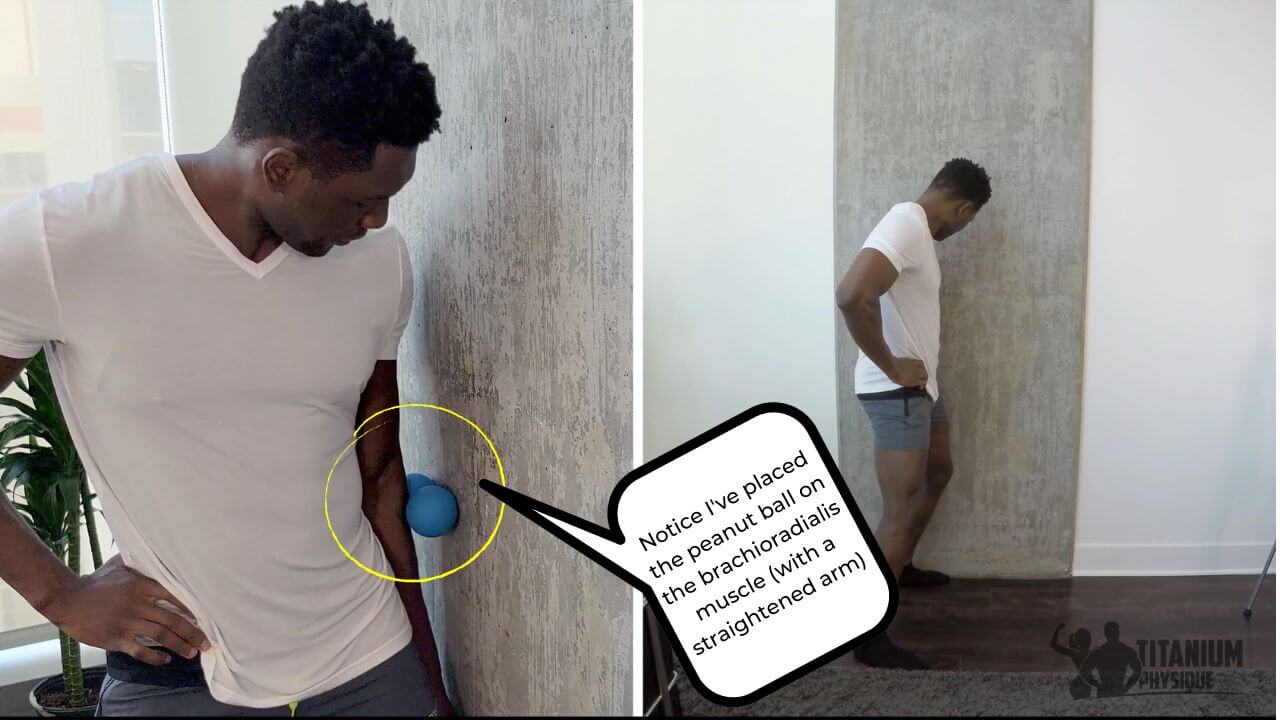
Exercise #1 — Massage the Brachioradialis Muscle
Massage the brachioradialis with a peanut ball.
- Use a peanut ball.
- Stand next to a wall, and place the peanut ball on the brachioradialis muscle in your forearm.
- Gently press your arm against the wall, applying pressure on the muscle, and roll the ball along the brachioradialis for 3-5 minutes.
- The "X" shown in the image below marks the common locations where tension and trigger points typically develop in the brachioradialis. Focus on those areas.
- Stretch the brachioradialis muscle by straightening your arm fully and gently flexing your wrist forward (toward the palm side), using your other hand to apply light pressure if needed.
Routine:
- Perform this exercise once a day. Rest the muscle the following day.
- For faster results, perform twice daily (morning and evening).
In the photo below, I demonstrate how to massage the brachioradialis muscle.

Exercise #2 — Massage the Wrist Flexor Muscles
Massage the wrist flexors with a lacrosse or peanut ball:
- Use a lacrosse or peanut ball.
- Sit at a table, place the ball on the table, and position your forearm flexor muscles (inner forearm) on top of the ball.
- Apply gentle pressure, rolling the ball along the wrist flexor muscles for 3-5 minutes. Roll from the elbow area toward the wrist. Rolling near the elbow targets the muscles, while the wrist area focuses on massaging the tendons.
- The "X" shown in the image below marks the common locations where tension and trigger points typically develop in the wrist flexors. Focus on those areas.
- Stretch the wrist flexors by straightening your arm and extending your wrist back (toward the back of your hand), using your other hand to apply light pressure.
Routine:
- Perform this exercise once a day. Rest the muscle the following day.
- For faster results, perform twice daily (morning and evening).
In the photo below, I demonstrate how to massage the wrist flexor muscle.


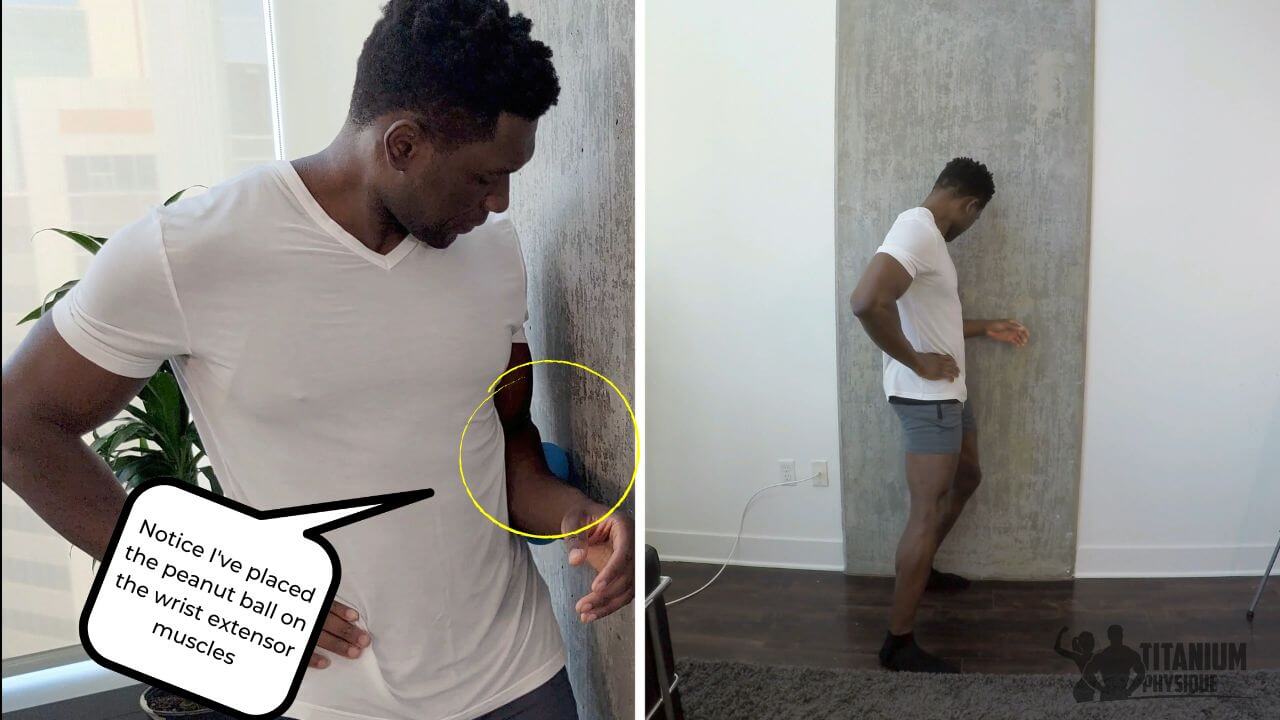
Exercise #3 — Massage the Wrist Extensor Muscles
Massage the wrist extensors with a peanut ball:
- Use a peanut ball.
- Stand next to a wall, and place the peanut ball on your forearm extensor muscles (outer forearm).
- Apply gentle pressure, rolling the ball along the wrist extensor muscles for 3-5 minutes. Roll from the elbow area toward the wrist. Rolling near the elbow targets the muscles, while the wrist area focuses on massaging the tendons.
- The "X" shown in the image below marks the common locations where tension and trigger points typically develop in the wrist extensors. Focus on those areas.
- Stretch the wrist extensors by straightening your arm and flexing your wrist forward (toward the palm side), using your other hand to apply light pressure.
Routine:
- Perform this exercise once a day. Rest the muscle the following day.
- For faster results, perform twice daily (morning and evening).
In the photo below, I demonstrate how to massage the wrist extensor muscles.

Exercise #4 — Thumb Pain and Strain
Thumb Pain (At the Base of the Thumb and Back of the Hand)
Massage the wrist extensor muscles and tendons:
- Use a peanut ball.
- Stand next to a wall, and place the peanut ball on your forearm extensor muscles (outer forearm).
- Apply gentle pressure, rolling the ball along the wrist extensor muscles for 3-5 minutes. Roll from the elbow area toward the wrist. Rolling near the elbow targets the muscles, while the wrist area focuses on massaging the tendons at the base of the thumb.
- Stretch the wrist extensors by straightening your arm and flexing your wrist forward (toward the palm side), using your other hand to apply light pressure.
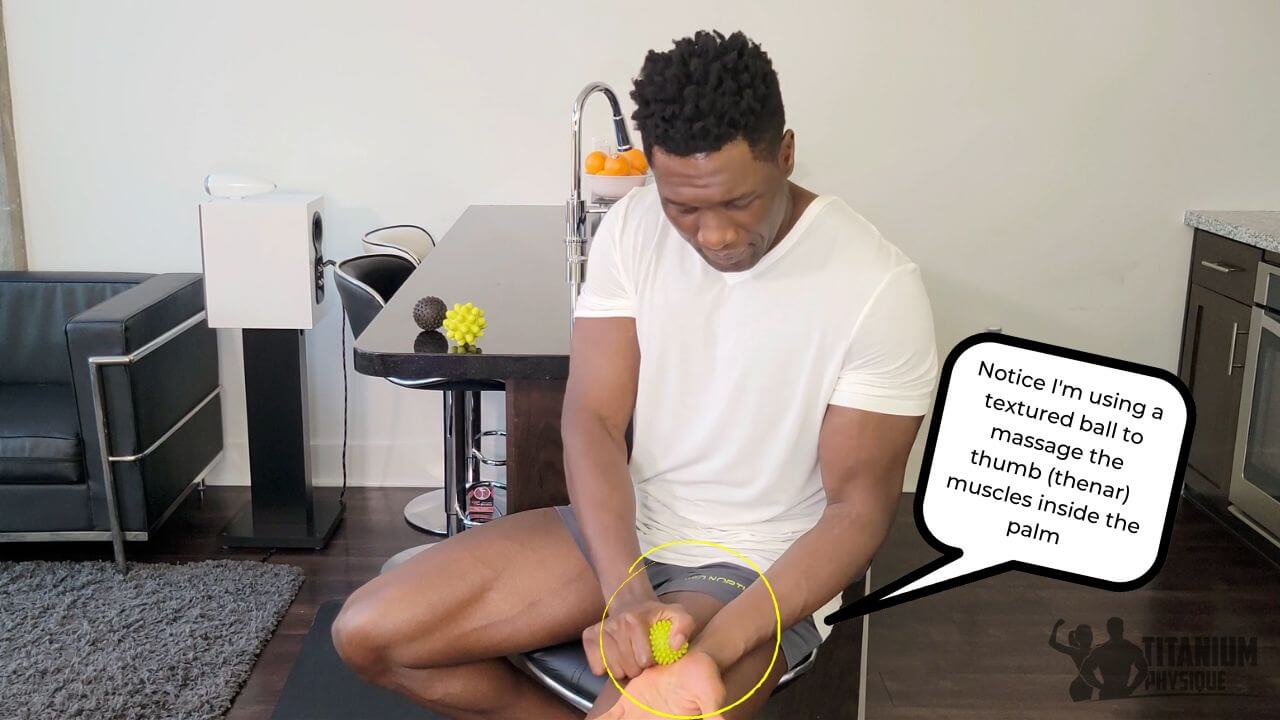
Thumb Strain (At the Base of the Thumb and Palm Side of Hand)
Massage the thenar muscles:
- Use a textured massage ball.
- Place the ball on a flat surface, then position the base of your thumb (the thenar muscles) on top of the ball.
- Apply gentle pressure, rolling the ball in small circles across the thenar muscles for 2-3 minutes, focusing on tender areas.
- The "X" shown in the image below marks the common locations where tension and trigger points typically develop in the thumb (thenar) muscles. Focus on those areas.
- Stretch your thumb by gently pulling on it with your other hand, holding for 15-20 seconds.
Routine:
- Perform these exercises once a day. Rest the area the following day.
- For faster results, perform twice daily (morning and evening).
In the photo below, I demonstrate how to address thumb pain and strain.

Exercise #5 — Wrist Ganglion Cyst and Ulnar Styloid Prominence
Addressing a wrist ganglion cyst or prominent ulnar styloid involves a holistic approach that addresses the entire forearm, including the wrist extensors, flexors, and thumb muscles.
Massaging and releasing tension in these interconnected areas can help reduce strain on the wrist joint, promote circulation, and may relieve discomfort associated with the cyst or prominent ulnar styloid.
Follow these exercises:
- Brachioradialis Muscle: Use a peanut ball to massage the brachioradialis muscle in the forearm, rolling from the elbow toward the wrist for 3-5 minutes. This targets muscle tension that can affect wrist mobility.
- Wrist Flexor Muscles and Tendons: Use a lacrosse ball to massage the wrist flexor muscles. Place the ball on a table and roll from the elbow to the wrist for 3-5 minutes, focusing on both muscle and tendon areas.
- Wrist Extensor Muscles and Tendons: Use a peanut ball against a wall to massage the wrist extensor muscles from the elbow down to the wrist, also for 3-5 minutes. This approach targets tightness in the outer forearm, helping alleviate strain on the wrist joint.
- Thumb Muscles: Use a textured massage ball on the thenar muscles (located at the base of the thumb and palm side) to relieve strain. Roll in small circles across the muscles for 2-3 minutes, and stretch the thumb gently after massaging.
Routine:
- Perform these exercises once a day. Rest the area the following day.
- For faster results, perform twice daily (morning and evening).
Ready to take the next step?
Our forearm and wrist pain program is designed to help eliminate pain, so daily activities no longer feel limited.
Resources
- Overview: Wrist injuries: https://www.ncbi.nlm.nih.gov/books/NBK563103/
- Wrist Pain: https://my.clevelandclinic.org/health/symptoms/17667-wrist-pain
- Chronic Inflammation: https://www.ncbi.nlm.nih.gov/books/NBK493173/
- Calcification: https://medlineplus.gov/ency/article/002321.htm
- The Magnesium Miracle (Second Edition) - Discover the Missing Link to Total Health, By Carolyn Dean, MD, ND: https://www.google.com/books/edition/The_Magnesium_Miracle_Second_Edition/2lBcDAAAQBAJ
- Genetics of Muscle Stiffness, Muscle Elasticity and Explosive Strength: https://www.ncbi.nlm.nih.gov/pmc/articles/PMC7706646/
- Inflammation: https://my.clevelandclinic.org/health/symptoms/21660-inflammation#overview
- Tendinopathy: Why the Difference Between Tendinitis and Tendinosis Matters: https://www.ncbi.nlm.nih.gov/pmc/articles/PMC3312643/
- Tendon Pathophysiology: https://www.physio-pedia.com/Tendon_Pathophysiology
- What Is the Evidence for Rest, Ice, Compression, and Elevation Therapy in the Treatment of Ankle Sprains in Adults: https://www.ncbi.nlm.nih.gov/pmc/articles/PMC3396304/
- Combined Treatment With Chondroitin Sulfate and Glucosamine Sulfate Shows No Superiority Over Placebo for Reduction of Joint Pain and Functional Impairment in Patients With Knee Osteoarthritis: A Six‐Month Multicenter, Randomized, Double‐Blind, Placebo‐Controlled Clinical Trial: https://acrjournals.onlinelibrary.wiley.com/doi/epdf/10.1002/art.39819
- Recognizing the Risks of Chronic Nonsteroidal Anti-Inflammatory Drug Use in Older Adults: https://www.ncbi.nlm.nih.gov/pmc/articles/PMC3158445/
- What You Should Know About Cortisone Shots: https://www.hss.edu/conditions_cortisone-shots.asp#shot-duration
- THE EFFECTS OF SELF‐MYOFASCIAL RELEASE USING A FOAM ROLL OR ROLLER MASSAGER ON JOINT RANGE OF MOTION, MUSCLE RECOVERY, AND PERFORMANCE: A SYSTEMATIC REVIEW: https://www.ncbi.nlm.nih.gov/pmc/articles/PMC4637917/
- Efficacy and Safety of Magnesium for the Management of Chronic Pain in Adults: A Systematic Review: https://journals.lww.com/anesthesia-analgesia/fulltext/2020/09000/efficacy_and_safety_of_magnesium_for_the.20.aspx
- Treatment of Tendinopathy: What Works, What Does Not, and What is on the Horizon: https://www.ncbi.nlm.nih.gov/pmc/articles/PMC2505250/
Contact About Privacy Terms | Copyright © 2026 TitaniumPhysique LLC.
Disclaimer: (1) Fitness results vary by individual effort, as such, individual results may vary; (2) We use Microsoft Clarity on our website to ensure you have the best possible browsing experience. Our privacy policy has more details.