
Knee Pain from Weightlifting: (A Helpful Guide for Lifters)
Written by: Nurudeen Tijani
The article below explains the root causes of knee pain from lifting.
For a guided program to address the pain, get access to TitaniumPhysique. The program is designed to eliminate knee pain, so you can train without limitations. Ready to get started?

Table of Contents
KEY TAKEAWAYS
- Knee Pain from Lifting: Athletes experience this condition due to tight glute, hip, quadriceps, and lower leg muscles that strain and inflame the knee tendons.
- Causes of Pain: The root causes of this pain are chronic inflammation, lack of magnesium, and muscle tightness.
- Injuries and Conditions: Knee issues associated with weight training include patellar and quadriceps tendonitis, popping, clicking, weakness, and instability.
- Non-Surgical Treatment and Prevention: To relieve or prevent this condition, keep the quadriceps and lower leg muscles pliable through self-myofascial release exercises.
Knee Tendonitis Pain: Why It Happens
When you lift weights, the quadriceps and hip flexor muscles become stiff and tight over time due to overuse. These tight muscles overstretch and inflame the quadriceps tendon, patellar tendon, and knee joint. This situation results in tendon injuries and pain in the knee during exercises such as squats, lunges, deadlifts, leg presses, deadlifts, and leg extensions. Knee issues are common among athletes and those involved in weight training.

Root Causes of Knee Tendonitis
The root causes of this condition include:

Root Cause #1: Chronic Inflammation
Weight training builds and strengthens muscles, but it also inflames tendons, ligaments, and joints in the body. When the workout targets or involves the knee, (e.g. squats, lunges, leg presses, leg extensions, deadlifts), it inflames the knee tendons and joints.
Inflammation of the knee tendons causes a “burning” sensation of pain around the knee. The condition is a type of tendonitis known as quadriceps tendonitis and patellar tendonitis.
The burning feeling and pain around the knee are signs of acute inflammation – meaning the pain is temporary. With time, the body heals the knee tendons, and the pain goes away. However, when the knee tendons cannot recover, and the inflamed tendon pain continues for three months or more, it becomes a chronic inflammatory condition.
Chronic inflammation is a state where the inflammatory process that enables the body to heal injured muscles, tendons, and ligaments is not working, and the body is no longer able to recover on its own. In this case, it leads to chronic knee tendonitis. Left untreated, chronic inflammation in the knee becomes degenerative and leads to irreversible deterioration of the knee joint.
Weightlifters experience discomfort in the knee during the following:
- Squats (Back or Front)
- Deadlifts (Conventional or Sumo Deadlifts)
- Lunges (Walking Lunges, Reverse Lunges)
- Bulgarian Split Squats
- Leg Press
- Leg Curls
- Leg Extensions
- Box Jumps
- Speed Skater Jumps
- Step-ups
Root Cause #2: Magnesium Deficiency
Calcium helps muscles contract. Magnesium helps muscles relax. When the body has excess calcium (which is often the case), muscles cannot relax and remain tense. When a muscle is tense, it pulls and puts tension on the tendons and joints, which inflames the tendons and causes pain, in this case – discomfort in the knee.
Magnesium also dissolves calcium and prevents the calcification of soft tissues. Calcification occurs when there is excess calcium in the body. Calcification hardens soft tissues like tendons and muscles. In this case, calcification of the quadriceps muscle and tendon leads to quadriceps tendonitis and patellar tendonitis.
According to The Magnesium Miracle (which is a scientific reference on the health effects of magnesium on the body), heavy exercise, physical activity, and factors such as caffeine, stimulants, diuretics, stress, and dehydration, deplete magnesium in athletes.
As such, it is crucial for athletes and those involved in weight training to actively replenish magnesium in the body.
40% of magnesium in the body is found in the muscles. Twitching muscles, muscle cramps and muscle spasms are signs of low magnesium levels in the body.
- The Magnesium Miracle - Discover the Missing Link to Total Health, By Carolyn Dean, MD, ND
Root Cause #3: Muscle Restriction

When you lift weights and perform exercises that target or involve the knee, the quadriceps, glutes, and hamstring muscles contract, become stiff and tight, and after some time, lose their elasticity.
Muscle restriction occurs when inelastic fibers become shortened and unable to release and lengthen back to their normal relaxed state.
In the case, lifting a weight that’s too heavy, or using bad form overstretch the quadriceps muscle and causes them to become restricted. This is usually the trigger that initiates the pain. When the quadriceps muscle gets restricted, they become shortened and get tighter.
Tight quadriceps muscle pulls and puts tension on the quadriceps tendon. As a result, it inflames the knee and causes pain during exercise. In some cases, restricted muscles also causes instability and weakness in the knee.
Weightlifters with restricted quadriceps experience:
- Sharp or severe pain in knee
- Burning pain in knee joint
- Instability and weakness in knee
- Difficulty and pain bending knee
- Difficulty and pain straightening knee
- Clicking and popping of knee joint and patella
TAKEAWAY: Root Causes of Knee Problems
- Inflammatory tendon pain (caused by strain and inflammation of the quadriceps femoris tendon that attaches to the patella)
Magnesium deficiency (which causes muscle pain and tendon pain)
Muscle pain (caused by stiff, tight, and restricted quadriceps, glutes, and hamstring muscles)
Knee Injuries, Conditions, and Symptoms
This section of the article will cover the types of tendonitis conditions athletes experience during exercise:
- Quadriceps tendonitis
- Patellar tendonitis
- Clicking and popping of the kneecap (patella) or knee joint
- Instability and weakness

Muscle anatomy chart of thigh and leg. The thigh comprises the quadriceps (rectus femoris, vastus medialis, vastus lateralis, vastus intermedius) and hamstrings (semitendinosus, semimembranosus, biceps femoris). The leg muscles include the gastrocnemius, soleus, fibularis longus, and tibialis anterior. The thigh and leg muscles contribute to pain, knee instability and weakness.
Quadriceps Tendonitis
This condition is a type of tendonitis where pain occurs at the top of the knee, above the patella. It’s also common to experience pain on the inside or outside part of the knee. To address this condition, we need to target and release all four quad muscles: rectus femoris, vastus medialis, vastus lateralis, and vastus intermedius.
These four thigh muscles combine into one tendon (quadriceps tendons) that inserts into the patella. When the quad muscles and quadriceps tendon get restricted, it pulls on the kneecap and causes pain during squats, lunges, leg extensions, deadlifts, and leg presses. Releasing these muscles will also get rid of pain on the inside or outside part of the knee.
Patellar Tendonitis
This condition is a form tendonitis where pain occurs below the kneecap. This pain is caused by strain and inflammation of the patellar ligament. The patellar ligament is a tissue that connects the kneecap to the shin bone. Patellar tendonitis is an extension of quadriceps tendonitis. By addressing quadriceps tendonitis, we also address and get rid of patellar tendonitis.
Clicking And Popping Of The Kneecap (Patella) and Knee Joint
It is common for weightlifters to experience clicking and popping of the kneecap and knee joint during leg extension and press. There are two causes for this.
- When the quadriceps muscle gets restricted, they pull on the quadriceps tendon and kneecap, which causes a “clicking and popping” sound in the kneecap during exercise. To resolve the clicking and popping of the kneecap, we need to target and release the quadriceps muscle.
- The thigh bone (femur) attaches to the leg bones (fibula and tibia) to form the knee joint. When the leg muscles (fibularis longus, gastrocnemius, and soleus) get restricted, they pull on the leg bones (fibula and tibia), which causes a "clicking and popping" sound in the knee joint during exercise. To resolve the clicking and popping of the knee joint, we need to target and release the leg muscles (fibularis longus, gastrocnemius, and soleus).
Instability And Weakness In The Knee
Instability and weakness in the knee are caused by restricted glutes, leg muscles (gastrocnemius, soleus, fibularis longus), and hamstring muscles. The quads are the power muscles of the thigh. The hamstrings are the stabilizing muscles of the thigh. The hamstrings, along with the leg muscles, help stabilize the knee. When the hamstrings and leg muscles become restricted, it causes instability and weakness in the knee. To resolve instability and weakness in the knee, we need to target and release the hamstrings and leg muscles.

A young man performing traditional back squats. This exercise involve the quadriceps, hamstrings, glutes, hip flexors, spinal erectors, and leg muscles. This movement and other variations can aggravate quadriceps tendonitis and patellar tendonitis. Athletes and weight lifters might also experience instability and weakness in the knee.

A man and woman performing dumbbell walking lunges. This exercise involve the quadriceps, hamstrings, glutes, hip flexors, and leg muscles. Walking, standing, or lateral lunges can aggravate quadriceps tendonitis and patellar tendonitis. Athletes and weight lifters might also experience instability and weakness in the knee.

A young woman performing leg presses. This exercise involve the quadriceps, hamstrings, glutes, hip flexors, and leg muscles. It can aggravate quadriceps tendonitis and patellar tendonitis. Athletes and weight lifters might also experience instability and weakness in the knee.

A man performing leg extensions. The exercise involve the quadriceps and leg muscles and can aggravate quadriceps tendonitis, patellar tendonitis, or "clicking and popping" of kneecap. Lifters might also experience instability and weakness in the knee.

A man performing traditional deadlifts. The traditional deadlift is a compound exercise that targets the major muscle groups in the body, including the shoulders, arms, back, glutes, thighs and leg. This exercise can aggravate quadriceps tendonitis and patellar tendonitis. Athletes might also experience instability and weakness in the knee.
How to Address the Root Cause of Knee Pain with the TitaniumPhysique Program
What is TitaniumPhysique? It is an effective and reliable way to resolve and prevent tendon pain from weight training, including:
- Sharp or severe pain in the knee
- Burning pain in the knee
- Instability and weakness in the knee
- Difficulty and pain bending knee
- Difficulty and pain straightening knee
- Clicking and popping of knee joint and kneecap
It is based on current and extensive scientific research relating to the following: tendinopathy, sports medicine and sports injury, musculoskeletal pain management, nutrition, supplementation, and, strength therapy and conditioning.
As a bodybuilder, I created the program for athletes and anyone who does weight training.
I've combined these scientific studies and nine years of experience as a personal trainer, nutritionist, bodybuilder, physique athlete, and wellness coach to create this program.
Here is an overview of how to resolve knee issues using program:
- Reduce chronic inflammation in the body. When you reduce chronic inflammation, injured and inflamed knee tendons recover faster.
- Supplement with magnesium to replenish muscle magnesium levels. Magnesium reduces inflammation and pain. Magnesium can help relax tense quadriceps muscles, and it can decalcify the quadriceps tendons, patellar ligament, and knee joint.
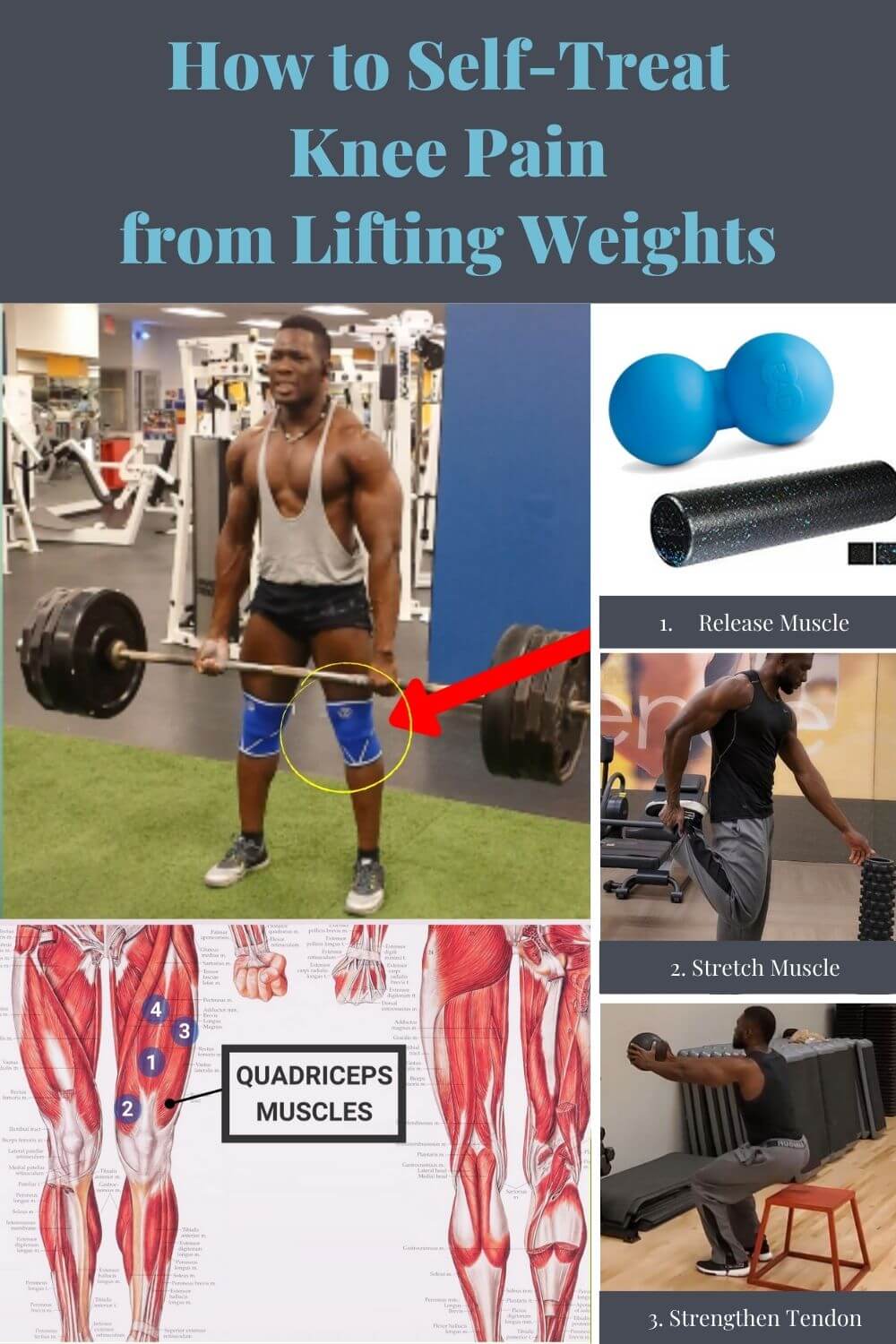
- Massage the thigh and glute muscles. You can use myofascial pain relief tools, like a massage ball, to massage and release the quadriceps muscles, hamstrings, and glutes.
Knee Pain Exercises
Restricted quadriceps muscles that cause pain develop over many years. As such, it is necessary to use the correct technique to get the best results. During this process, it is also vital to strengthen the knee by doing mobility and strengthening exercises for the knee joint.
Strengthening exercises are therapeutic and can help the knee tendons recover faster and regain full strength for maximum performance. The following mobility exercises target the stabilizing muscles of the knee joint and strengthen the tendons:
- Bosu Ball Squats
- Lateral Side-Steps
- Step Down Exercise
- One-Legged Squat
- Chair Squat
Self-Myofascial Release Tools for Knee Pain

Massage balls and foam rollers can effectively release tight muscles relieve tendonitis. If you experience discomfort, these tools will help.
The peanut ball can release the muscles at the front of the thigh. The foam roller can release the glutes and outer thigh muscles (vastus lateralis). The medicine ball can release the hamstrings.
These tools resolve pain and relieve the knee tendon and joint by releasing restricted muscles.
For a detailed guide on performing self-myofascial release correctly and effectively, get access to my step-by-step video program to relieve muscle and tendon injuries. Get Started Now.
References
• Understanding and Managing Chronic Inflammation
https://www.healthline.com/health/chronic-inflammation
• The Magnesium Miracle (Second Edition) - Discover the Missing Link to Total Health, By Carolyn Dean, MD, ND
https://www.google.com/books/edition/The_Magnesium_Miracle_Second_Edition/2lBcDAAAQBAJ
• Calcification
https://medlineplus.gov/ency/article/002321.htm
• The China Study Solution - The Simple Way to Lose Weight and Reverse Illness, Using a Whole-Food, Plant-Based Diet
https://www.google.com/books/edition/The_China_Study_Solution/nrazCwAAQBAJ
• The Acid Alkaline Balance
https://www.pccmarkets.com/sound-consumer/2009-10/sc0910-acid-alkaline/
Contact About Privacy Terms | Copyright © 2026 TitaniumPhysique LLC.
Disclaimer: (1) Fitness results vary by individual effort, as such, individual results may vary; (2) We use Microsoft Clarity on our website to ensure you have the best possible browsing experience. Our privacy policy has more details.