
Tendonitis from Lifting Weights (A Helpful Guide)
Written by: Nurudeen Tijani
The article below explains the root causes of tendonitis from lifting weights.
For a guided program to address the pain, get access to TitaniumPhysique. The program is designed to eliminate tendon pain, so you can train without limitations. Ready to get started?

Table of Contents
KEY TAKEAWAYS
- Tendonitis in Weightlifters: Athletes and gymgoers experience this condition when lifting due to tight muscles that strain and inflame the tendons.
- Causes of Pain: The root causes of this pain are chronic inflammation, muscle tightness, and subluxation.
- Injuries and Conditions: Tendonitis in the shoulder, elbow, forearm, wrist, hip, knee, and foot are often associated with weight training.
- Treatment and Prevention: To fix and prevent tendon problems, keep muscles pliable through self-myofascial release exercises and supplement with magnesium.
Concerns with Traditional Solutions: Traditional remedies alleviate symptoms without addressing the root cause of the pain. Holistic solutions like the TitaniumPhysique Program are designed to treat, fix, and prevent tendon injuries.
Does Weight Lifting Cause Tendonitis?
Yes, lifting weights can cause tendonitis. Tendon injuries are a major medical problem in sports due to increased participation in recreational sports such as weight training. These injuries are common in those who do the same exercise activities repeatedly. This is because the tendon becomes strained and inflamed due to overuse. This condition is common among athletes, weight lifers, and those involved in intense physical activities.

Root Causes of Tendonitis
The root causes of this condition are:

Root Cause #1: Chronic Inflammation
Weight training strengthens muscles, but it also inflames tendons, joints, and ligaments in the body. The inflammation of tendons produces the "burning" sensation and is a sign of acute inflammation.
With time, the body heals, and the inflammation goes away. However, when the body is unable to recover, and the inflamed tendon and joint pain continue for more than three months, it is characterized as a chronic condition.
Chronic inflammation is a state where the inflammatory process that allows the body to heal is not working. When left untreated, this condition breaks down the body.
Weightlifters with chronic inflammation experience the following conditions:
- Elbow pain
- Shoulder pain
- Forearm and wrist pain
- Knee pain
- Foot and heel pain
Root Cause #2: Muscle Restriction
Muscle restriction occurs when muscle fibers become shortened and are unable to release and lengthen back to their normal state. A traumatic event like excessively heavy weights or using a bad form can strain muscles and cause muscle injury. When this happens, the joints around the injured tissue become weaker.
To support the joint, the muscles surrounding the joint shorten, tighten up, and form knots. The muscle gets restricted and becomes dysfunctional.
Tight muscles pull and put tension on the tendons and joints. As a result, it inflames the tendons and creates inflammation in the body, which leads to more pain.
Weightlifters with dysfunctional and restricted muscles experience:
- Shoulder pain
- Wrist pain
- Forearm pain
- Knee pain
- Back pain( upper, mid-back, and lower back)
- Leg, foot, and heel pain

Root Cause #3: Joint Subluxation
Restricted muscles pull tighter on the joints. Over time, this causes the joints to move out of their normal position. This condition is known as a subluxation, and it can affect the joints and nervous system in the body, leading to pain. The misaligned joints can stretch and choke the nerves, leading to sharp nerve pain in the body.
Misaligned joints can lead to an irritating "clicking" or popping sound of joints. Misaligned joints also inflame the tendons and ligaments, creating excessive inflammation that leads to more discomfort.
Weightlifters with subluxation experience
- Back pain (e.g., during deadlifts)
- Shoulder pain (e.g. during bench presses)
- Knee pain (e.g., when squatting or after squats)
- Wrist pain (e.g., during bicep curls or push-ups)
- Neck pain (e.g., during shoulder shrugs)
Conventional Remedies for Tendonitis
Conventional remedies include joint supplements, painkillers (NSAIDs), physical therapy, braces, straps, sleeves, kinesiology tape, oils, creams, "ice and rest."
As someone who struggled with chronic tendon injuries from weight training, I've tried the usual conventional treatments during my search to fix this problem.
Are conventional remedies the best treatment for this condition?
In my research and 10 years of experience as a trainer and bodybuilder, I found these remedies produced barely any relief for tendon injuries.
Conventional treatments are ineffective because they can only relieve symptoms, not the root cause of the condition. As a result, the injury does not heal and often comes back. If you are anything like me and have tried these solutions, I am sure you can relate.
The following is a list of traditional solutions for tendon injuries, as well as their pros and cons.

Anti-Inflammatory Gel, Joint Supplement, Pain Killers, Sports Tape and Knee Sleeves for Joint Aches.
Pros & Cons of Conventional Remedies
R.I.C.E. Method (Rest, Ice, Compress and Elevate)
Pro: The R.I.C.E. protocol can help treat acute pain. Weightlifters with acute discomfort experience a burning sensation of pain in the affected joint after working out. Applying ice (also known as cold therapy) on the joint after working out reduce inflammation and help the inflamed tendon calm and heal.
Con: R.I.C.E. treats symptoms but does not fix the root cause, so the pain usually persists. If your condition is chronic (lasting over three months), the R.I.C.E. treatment produces little to no relief.
Joint Supplements & Health Vitamins
Joint supplements and joint vitamins are common treatment options. Most joint supplements contain Methylsulfonylmethane (MSM) and Chondroitin. The cartilage of joints contains MSM and chondroitin. It's generally believed these supplements help ease pain in the joints and promote good joint health.
Pro: Joint supplements can provide temporary relief for acute pain. As such, they are beneficial when used as part of a prevention or "maintenance routine".
Con: In my search to treat and fix my chronic pain, I supplemented with MSM, Chondroitin, Turmeric, and Fish Oil (for years).
These supplements did not provide relief because they cannot fix the root cause of tendon injuries from weight training. According to a 2016 Arthritis & Rheumatology research, MSM and Chondroitin provided no benefit in reducing chronic joint pain.
Anti-Inflammatory Painkillers (NSAIDs)
Pro: Nonsteroidal anti-inflammatory drugs (NSAIDs) or painkillers are another popular treatment option. They help reduce acute inflammation in the body. By reducing inflammation, NSAIDs temporarily reduce pain in the body and joints.
Con: Painkillers treat the symptoms and not the root cause of chronic pain. As a result, the discomfort often returns. Research shows NSAIDs' long-term use can create health issues such as gastrointestinal side effects and kidney disease.
Joint Injections (Cortisone Shot)
Pro: A cortisone shot is a steroid medication injected into the problem joint. The steroid provides relief by temporarily suppressing inflammatory pain in the affected joints. The relief from a cortisone shot usually lasts for six weeks to six months.
Con: The cortisone shot only suppresses the pain. As a result, when the effects of the steroid wear off, the pain immediately comes back. Besides, repeated use of cortisone injections creates long-term health side effects such as damaged cartilage, joint infection, and nerve damage.
Pain Relief Oils & Anti-Inflammatory Joint Creams, Spray, Gels
Most topical relief options like pain relief oils, creams, sprays, and gels contain MSM or other anti-inflammatory medications.
Pro: They can help treat acute inflammatory pain. They can also be useful when used as part of a "maintenance routine". For example, when used as a lubricant to massage muscles and tendons after a workout.
Con: If your condition is chronic, topical pain relief solutions provide little to no relief in reducing tendon pain. Topical pain relief remedies cannot treat the root causes of tendon injuries experience by weight-training athletes.
Strength Therapy & Physical Therapy
Pro: Strength therapy is an essential aspect of tendinosis treatment. Tendinosis is the degeneration of tendon collagen. Tendinosis results in the loss of strength in the tendon and often leads to tendon rupture. Therapy is required to heal injured tendons and regain full strength for maximum athletic performance.
Con: When used out of step (often the case), physical therapy can be a waste of time for most people. Before treating tendinosis pain with strengthening exercises, it is necessary to fix chronic inflammation and muscle restriction created by weight training.
Joint Brace, Sleeve, Strap & Support
Pro: This solution help by putting compression on the tendon and joint. As a result, it temporarily reduces pain in the joints during exercise.
Con: Sleeve, straps and support braces provide temporary relief by covering up the problem, which only prolongs the condition.
Sports Tape, Kinesiology Tape (KT Tape) Therapy
Athletes commonly use sports tape and KT tape to treat tendon injuries. They provide support for injured muscles and tendons.
Pro: When applied correctly, they can reduce muscle and tendon pain, and stabilize affected joints.
Con: Sports tapes and kinesiology therapy (used in the wrong way) cover up the problem, which only prolongs and worsens the condition.
Pain Relief Patch
There two types of pain relief patch: medicated and non-medicated.
Medicated patches contain nonsteroidal anti-inflammatory medication and are applied directly to the pain area (e.g. lower back) to relieve pain. Non-medicated pain relief patches, like nanotech patches, claim to use nanotechnology to support your body's natural ability to fight pain.
Nanotech patches help the body send signals to the brain to reduce pain by assisting the body to communicate with the brain effectively.
Pro - Medicated Patch: Medicated patches provide temporary pain relief. The relief typically last for a few hours.
Con - Medicated Patch: Medicated patches temporarily mask the pain, which only prolongs the real problem. They do not fix the root cause of the condition, so the pain usually persist. Medicated patches can also cause long term gastrointestinal (stomach and gut) side effects.
Pro - Nanotech Patches: They can be useful when used as part of a "maintenance routine" to prevent discomfort. For example, when used post-workout to treat acute pain.
Con - Nanotech Patches: They cannot fix the underlying issues that cause pain for weightlifters.
Stretching
Like physical therapy, stretching plays a vital role in treating and managing chronic inflammation from weight training.
Pro: Stretching helps lengthen muscles. It increases nutrients, blood, and oxygen and removes waste from chronic inflammatory muscle and tendons, thereby helping the injury heal faster.
A stretching technique like Kinetic Chain stretching can elongate the connective fascia sheet of a muscle group. In doing so, it helps reduce tension on the tendons within that muscle group. When muscles and tendons are in a healthy lengthened state, it can decrease pain.
Con: Like physical therapy, when used out of step (often the case), stretching does little to relieve pain from tendon injuries. Before treating pain with stretching, fix chronic inflammation and muscle restriction.
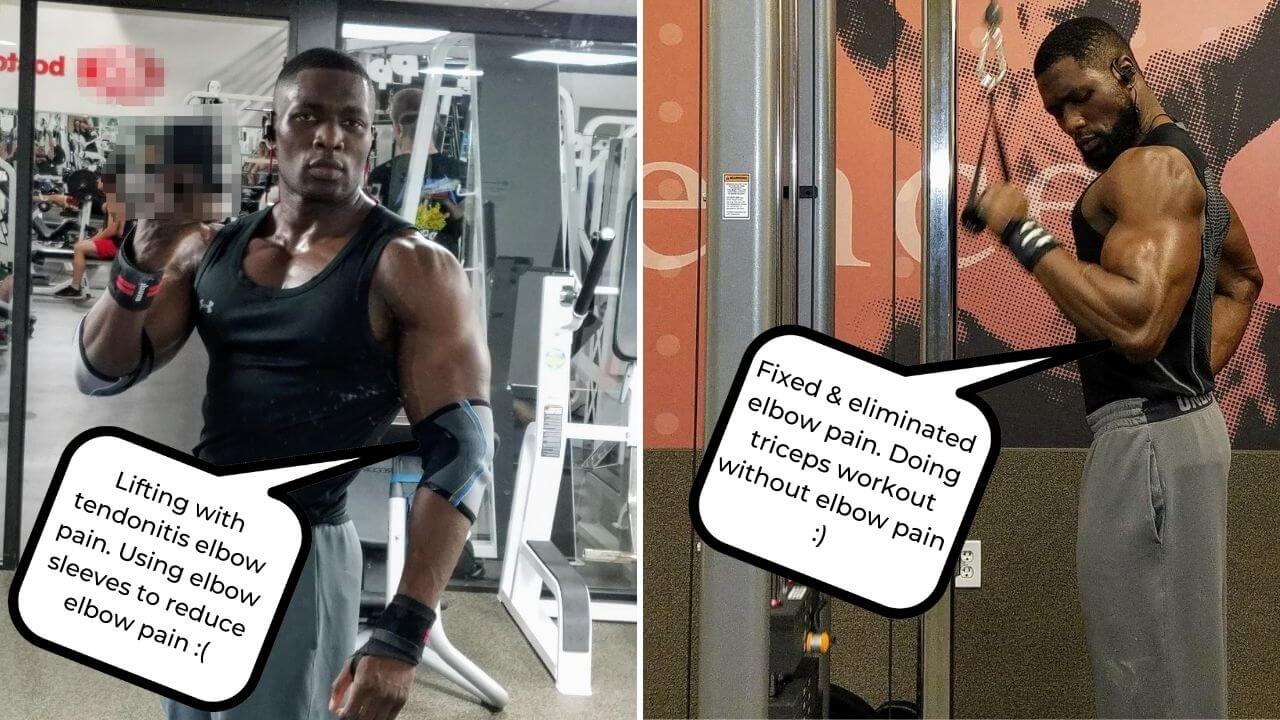
The photo above is a Before and After of me. Left image (2016) wearing compression sleeves to manage chronic pain. In the right photo (2019), I fixed my injuries using the TitaniumPhysique Program.
The TitaniumPhysique System (An Effective and Sustainable Pain Treatment Program)
The TitaniumPhysique program is a complete self-treatment program for joint aches, muscle pain, and tendon injuries.
I created the program for athletes and anyone involved in weight training.
It is based on current and extensive scientific research relating to tendinopathy, sports medicine and sports injury, musculoskeletal pain treatment and management, nutrition, supplementation, and, strength therapy and conditioning.
As a bodybuilder who previously struggled with chronic pain from tendon injuries, I understand most athletes experience chronic and concurrent tendonitis conditions.
The program is a holistic approach to tendon and muscle injury treatment. It's a simple, easy-to-follow, convenient, sustainable, and highly effective strategy that helped me eliminate chronic pain.
Step 1: Get Better
This step resets and repairs the inflammatory process in the body to get better. The inflammatory process controls the body's ability to fight and relieve pain. When the body is in a chronic inflammatory state, everything will be in pain. This step alone can neutralize and stop tendon or joint discomfort, allowing injured tendons to heal.

Step 2: Perform Better
High protein foods and sports supplements create acidity in the body. Becoming alkaline means making sure the pH level of the body is optimal and not acidic. When your body is alkaline, you will have more energy and less pain.
Becoming alkaline also helps speed up post-workout recovery by boosting blood circulation and nutrients and reducing acute inflammation of the muscles, tendons, and joints.

Step 3: Feel Better
This step involves muscle release and joint mobility exercises to stimulate repair, neutralize pain, and strengthen problem joints. Using the correct self-myofascial release (SMR) tool can help you release tight muscles and provide INSTANT relief.
If you experience any of the following conditions, this step will help:
- Tension, tightness, or stiffness in neck/upper back
- Shoulder pain
- Elbow pain
- Forearm pain
- Wrist pain
- Back pain (upper and lower back)
- Knee pain
- Leg, foot, or heel pain

Fix and Prevent Tendon & Muscle Injuries
Here's how to implement the TitaniumPhysique program to fix and prevent tendon injuries from coming back when you resume weightlifting.
Step 1: Reduce Inflammation to Get Better
The food you eat is critical in getting rid of inflammatory pain. It is either going to cause and aggravate inflammation in the body or fight pain and provide relief. According to The China Study Solution (the most comprehensive scientific study on nutrition), animal foods and animal food products aggravate inflammation in the gastrointestinal tract.
Combined with the stress frequent and prolonged weight training creates on the tendons and joints, the body unavoidably gets into a chronic inflammatory state. This systemic cycle of inflammatory foods and physical fitness is the number #1 reason most athletes and gymgoers experience chronic inflammatory pain after a few months of weight training.
Joint supplements cannot fix chronic inflammation from weights training because it is a systemic problem. To fix chronic pain, you can use a simple two-week whole-food plant-based regimen to reset and eliminate chronic inflammation in the body.
Implementing a whole-food plant-based (WFPB) regimen to reset chronic inflammation does not require becoming a vegetarian or vegan if that is not your goal. It is simply a tool to reset. There is a specific way to use this strategy to get the fastest and best results, especially for athletes focused on building muscles, strength, weight loss, and burning fat. The TitaniumPhysique program provides a step-by-step plan to achieve this.
The food you eat is more important than anything your doctor can give you to cure disease and pain. A plant-based diet can help eliminate joint pain and reverse chronic diseases like arthritis.
- The China Study Solution: The Simple Way to Lose Weight and Reverse Illness, Using a Whole-Food, Plant-Based Diet.

Is a whole-food, plant-based (WFPB) diet suitable for you? The questions below can assist you in making a decision:
- Do you lift weights or work out at least four times a week?
- Do you experience dull and achy pain or a burning sensation in your tendons and joints after working out?
- Do you have concurrent symptoms of tendonitis conditions?
- If you experience pain, has it persisted over three months?
- Does your diet primarily consist of protein from animal sources and animal-based products (e.g., chicken, meat, dairy, whey/casein protein)?
If you answered YES to any of the questions above, implementing a WFPB regimen can help reduce inflammation, promote the healing, and alleviate chronic injuries.
Adopting a whole-food, plant-based approach to reset chronic inflammation does not require becoming a vegetarian or vegan unless that is your personal goal. It is simply a tool for resetting.
There is a specific way to use this strategy to achieve fast and lasting results, particularly for athletes and individuals who aim to build muscle, increase strength, lose weight, and burn fat. The TitaniumPhysique Program provides a step-by-step plan to help you accomplish this.
Magnesium Therapy
Magnesium is a potent anti-inflammatory that can help reduce pain. It also plays a vital role in helping muscles relax. Calcium helps muscles contract, and magnesium help muscles relax. When the body has excess calcium (often the case), muscles remain tense. Twitching muscles, muscle cramps and muscle spasms are signs of low magnesium levels in the body.
Magnesium also dissolves calcium and prevents calcification of soft tissues like tendons. Calcification occurs when there is excess calcium in the body. Calcification hardens soft tissues, which can lead to inflammation and joint aches.
According to The Magnesium Miracle, heavy exercise, sauna therapy and stimulants such as workout supplements (pre-workout) deplete magnesium in athletes. As such, it is crucial for athletes and those involved in weight training to actively replenish magnesium and use the right kind of magnesium to get the therapeutic effect. The TitaniumPhysique Program provides an easy-to-follow plan for magnesium therapy.
"Magnesium is the body's most important anti-inflammatory."
- The Magnesium Miracle - Discover the Missing Link to Total Health, By Carolyn Dean, MD, ND

Step 2: Alkaline to Perform Better
Research shows high protein foods and sports supplements create acidity in the body. When your body is alkaline, you will have more energy and less joint pain. Going alkaline is simple. Anyone can take simple steps to become more alkaline and less acidic. Here are four simple ways to become more alkaline.
4 Simple Ways to Alkaline
- Wheatgrass and MSM powder. Mix water, wheatgrass, and MSM powder, and you get the perfect alkalizing drink.
- Dark leafy green vegetable smoothie. Most vegetables, especially dark leafy greens, beets, and fruits, are alkaline.
- Lemon water. The rich alkaline mineral content in lemons produces an alkalizing effect that exceeds the level of citric acid in lemons.
- Apple cider vinegar. A mixture of apple cider vinegar, honey, and hot water produces an alkaline shift in the body when taken on an empty stomach.

Step 3: Release Restricted Muscles to Feel Better
Chronic muscle and tendon injuries cannot heal if the body is in a persistent inflammatory state. After reducing chronic inflammation, we can heal injuries and eliminate pain easier and faster.
Restricted muscles pull tighter and put tension on the tendons and joints. Releasing tight muscles increases the elasticity of the muscle and tendon and immediately reduces joint and tendon pain.
Myofascial Release Tools for Tendon Pain
Chronically restricted and dysfunctional muscles usually develop over many years. As such, it is vital to use the correct technique to release these tight muscles. It is also crucial to strengthen the joints of the muscles being released by doing joint mobility exercises to avoid re-injury and regain full strength for maximum performance.
The TitaniumPhysique Program provides full-body joint mobility exercise videos and step-by-step videos on how to release restricted muscles.
The following are some of the tools you can use to release dysfunctional and restricted muscles.


Foam Rollers
The Rumble Roller (RR) and foam roller are vital myofascial release tools. These tools help release and treat restricted and dysfunctional muscles.
The foam roller works best on sensitive muscles, while the aggressive design of the rumble roller allows it to dig deeper and break up adhesions in the muscle. These rollers can help treat pain in the shoulder, knee, and foot.
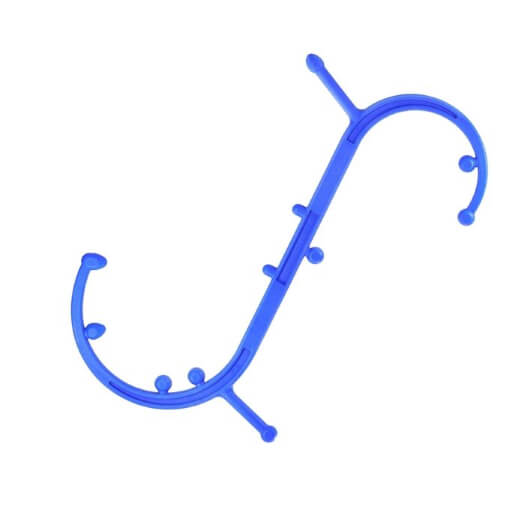
Theracane
The Theracane is highly effective in treating various muscles. I find it particularly useful in treating shoulder and neck muscles.
The Theracane can target and release the infraspinatus, supraspinatus, rhomboids, teres minor, teres major muscles, and levator scapulae. These collective group of muscle cause pain in the shoulder, neck, and upper back.
Massage Balls
Massage balls are effective pain relief tools to treat tendonitis.
The peanut ball can release the forearm extensors, flexors, and triceps muscles to alleviate pain in the forearm, wrist, and elbow. The BodyStar ball can release the lower trapezius and rhomboids to fix shoulder blade pain.
For a detailed guide on performing self-myofascial release correctly and effectively, get instant access to my step-by-step SMR video guide to quickly fix muscle and tendon injuries. Click here to access the TitaniumPhysique Program.
References
• Tendinopathy in Sport
https://www.ncbi.nlm.nih.gov/pmc/articles/PMC3435934/
• Understanding and Managing Chronic Inflammation
https://www.healthline.com/health/chronic-inflammation
• Tendinitis: Symptoms, causes, and treatment
https://www.medicalnewstoday.com/articles/175596
• Effects of glucosamine, chondroitin, or placebo in patients with osteoarthritis of hip or knee: network meta-analysis
https://pubmed.ncbi.nlm.nih.gov/20847017/
• Combined Treatment With Chondroitin Sulfate and Glucosamine Sulfate Shows No Superiority Over Placebo for Reduction of Joint Pain and Functional Impairment in Patients With Knee Osteoarthritis: A Six‐Month Multicenter, Randomized, Double‐Blind, Placebo‐Controlled Clinical Trial
https://onlinelibrary.wiley.com/doi/full/10.1002/art.39819
• The latest on glucosamine/chondroitin supplements
https://www.health.harvard.edu/blog/the-latest-on-glucosaminechondroitin-supplements-2016101710391
• The China Study Solution: The Simple Way to Lose Weight and Reverse Illness, Using a Whole-Food, Plant-Based Diet, By Thomas Campbell, MD
https://www.google.com/books/edition/The_China_Study_Solution/nrazCwAAQBAJ
• The Magnesium Miracle - Discover the Missing Link to Total Health, By Carolyn Dean, MD, ND
https://www.google.com/books/edition/The_Magnesium_Miracle_Second_Edition/2lBcDAAAQBAJ
• Cortisone Shots
https://www.mayoclinic.org/tests-procedures/cortisone-shots/about/pac-20384794
• Tendinopathy: Why the Difference Between Tendinitis and Tendinosis Matters
https://www.ncbi.nlm.nih.gov/pmc/articles/PMC3312643/
• Open and Closed Kinetic Chain in Physical Therapy
https://www.verywellhealth.com/open-and-closed-kinetic-chain-296949
• Tips for Limiting Acidic Foods
https://www.healthline.com/health/acid-foods-to-avoid
• Calcification
https://medlineplus.gov/ency/article/002321.htm
• Recognizing the Risks of Chronic Nonsteroidal Anti-Inflammatory Drug Use in Older Adults
https://www.ncbi.nlm.nih.gov/pmc/articles/PMC3158445/
• The Acid Alkaline Balance
https://www.pccmarkets.com/sound-consumer/2009-10/sc0910-acid-alkaline/
Contact About Privacy Terms | Copyright © 2026 TitaniumPhysique LLC.
Disclaimer: (1) Fitness results vary by individual effort, as such, individual results may vary; (2) We use Microsoft Clarity on our website to ensure you have the best possible browsing experience. Our privacy policy has more details.